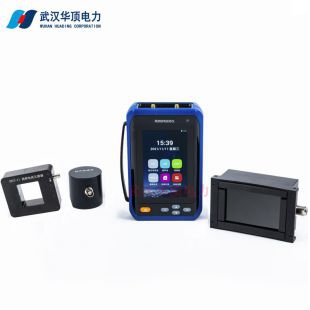
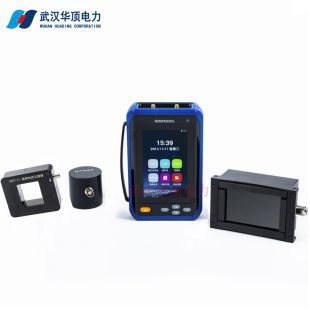
The HDJF-V Partial Discharge Inspection Instrument integrates two measurement methods: ultrasonic and ultra-high frequency (UHF). The main unit comes with built-in ultrasonic capability; UHF requires a signal conditioner.
I Product Overview
Partial discharge is a pulse discharge that generates a series of physical phenomena and chemical changes, such as light, sound, electrical, and mechanical vibrations, both inside and in the surrounding space of power equipment. These physical and chemical changes accompanying partial discharge can provide detection signals for monitoring the internal insulation status of power equipment. When insulation defects occur inside high-voltage electrical equipment, partial discharge signals are generated. By detecting and analyzing partial discharge signals, it is possible to determine whether there are insulation hazards inside high-voltage electrical equipment, preventing potential accidents from escalating.
The partial discharge inspection instrument developed by our company is a multifunctional handheld device based on ultrasonic and UHF detection methods. It tests the partial discharge condition of equipment, can read the partial discharge amplitude and spectrum waveforms, and provides storage and readout functions for 2D and 3D spectra, enabling a good assessment of partial discharge in electrical equipment. The partial discharge inspection instrument is suitable for partial discharge detection in electrical equipment such as GIS, switchgear, transformers, and power cables. The device is portable and easy to operate, and all detections have no impact on the operation of high-voltage equipment. This product allows multi-cycle observation of measurement signals, frequency identification of discharges, and analysis through multiple modes, enabling clear fault diagnosis.
The partial discharge inspection instrument features a brand-new appearance design and uses the currently popular Android system, making it easier to operate. Additionally, it integrates a 5-megapixel camera for inspection records; RFID facilitates the expansion of IoT applications; and it includes a built-in discharge type library for convenient comparison and verification of discharge conditions.
Referenced Standards
Partial Discharge Measurements GB/T 7354
Guide for On-site Partial Discharge Measurement of Power Equipment DL/T 417
High-Voltage Test Techniques Part 1: General Test Requirements GB/T 16927.1
High-Voltage Test Techniques Part 2: Measuring Systems GB/T 16927.2
High-Voltage Test Techniques Part 3: Definitions and Requirements for On-site Tests GB/T 16927.3
Measurement Principle
Ultrasonic (US) Used for detecting partial discharge in various electrical equipment
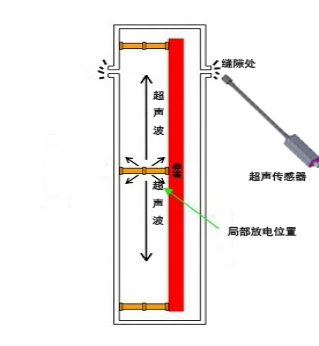
Before partial discharge occurs, the electric field force, mechanical stress of the insulating medium, and particle forces around the discharge point are in a relatively balanced state. When partial discharge occurs, the rapid release or migration of charges changes the electric field, breaking the balance and causing oscillatory mechanical motion of surrounding particles, thereby generating sound or vibration signals. The ultrasonic method measures partial discharge signals by installing ultrasonic sensors on the outer wall of the equipment cavity. This method is characterized by no electrical connection between the sensor and the electrical circuit of the equipment, making it immune to electrical interference. However, it is susceptible to ambient noise or mechanical vibrations of the equipment during on-site use. Due to the significant attenuation of ultrasonic signals in common insulating materials of power equipment, the detection range of the ultrasonic method is limited, but it has the advantage of high positioning accuracy. The frequency spectrum of sound waves generated by partial discharge is very wide, ranging from tens of Hz to several MHz. Signals below 20 kHz can be heard by the human ear, while ultrasonic signals above this frequency must be received using ultrasonic sensors. By measuring the sound pressure level of the ultrasonic signal, the intensity of the discharge can be inferred.
UHF (Ultra-High Frequency) used for detecting partial discharge in GIS combined electrical equipment
The insulation strength and breakdown field strength of insulating materials in power equipment are very high. When partial discharge occurs in a very small area, the breakdown process is very fast, generating steep pulse currents with rise times less than 1 ns, and exciting electromagnetic waves with frequencies up to several GHz. The basic principle of the UHF method for partial discharge detection is to use UHF sensors to detect the UHF electromagnetic wave signals (300MHz ≤ f ≤ 3GHz) generated during partial discharge in power equipment, thereby obtaining relevant information about partial discharge and achieving partial discharge monitoring. Depending on the on-site equipment conditions, built-in UHF sensors or external UHF sensors can be used. Since corona interference on site is mainly concentrated below the 300 MHz frequency band, the UHF method can effectively avoid corona and other interference, offering high sensitivity and anti-interference capability. It enables live detection, positioning, and defect type identification of partial discharge.
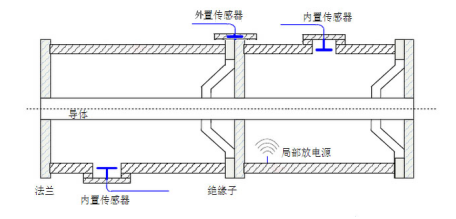
UHF Measurement Principle Diagram
Technical Parameters
Table 4‑1 Technical Parameters Table
Main Unit Parameters |
|
Number of Detectable Channels | 2 channels: 1 US, 1 UHF (wireless) |
Sampling Accuracy | 12bit |
Synchronization Method | Internal sync, external sync, optical sync |
Contact US |
|
Frequency Range | 20kHz~300kHz |
Output Impedance | 50Ω |
Detection Sensitivity | 0.1mV |
Measurement Range | 0.1mV~1V |
Output Interface | Standard SMA connector to main unit |
UHF |
|
Detection Bandwidth | 300MHz~1.5GHz |
Output Method | BNC connector - signal conditioning unit, wireless connection to main unit |
Receiving Method | Antenna reception |
Transmission Method | Coaxial cable |
Detection Sensitivity | <-60dBm |
Hardware |
Display Screen | 5.0-inch TFT true color LCD screen |
Resolution | 800×480 |
Operation | Touch/Keys |
Storage | TF card |
Interface | 3.5mm stereo headphone jack |
Power Supply | DC-12V/2A DC power supply |
Expansion Functions | USB-TypeC/5MP camera/RFID/WIFI/Bluetooth |
Power |
|
Internal Power | Battery powered (4800mAH 7.4V) |
Normal Operating Time | Approximately 7 hours, full charge time approximately 3 hours |
Dimensions |
Length×Width×Height | 235mm×133mm×48mm |
Weight | 0.85kg |
Environment |
|
Operating Ambient Temperature | -20℃~50℃ |
Storage Ambient Temperature | -40℃~70℃ |
Humidity | 10%-90% (non-condensing) |
Altitude | ≤3000m |