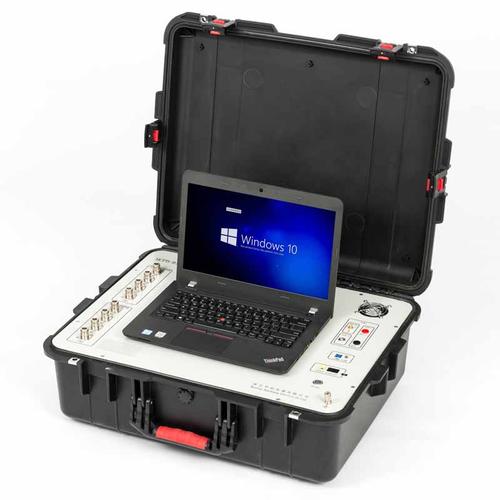
Introduction to Partial Discharge Tester:
Darui Electric recommends
The ultrasonic partial discharge detector can sense high-frequency signals generated by equipment faults, vibrations, leaks, and electrical partial discharges in operating machinery. It uses a unique heterodyne method to convert these signals into audio signals, allowing users to hear these sounds through headphones and see intensity indications on the gauge. The heterodyne principle is like a radio, accurately converting signals into sound, making it easy for people to identify and understand. The advantage of using ultrasonic technology is that it is easy to understand and convenient. Ultrasound is a high-frequency short-wave signal that is not directly audible to the human ear. When we use a full-function ultrasonic detector, we can fully detect these sounds.
Partial Discharge Tester:
[Including mechanical fault detection and gas/liquid leak detection in electrical equipment]
1. GIS switch operating mechanism fault finding, preventing switch refusal and maloperation accidents
GIS is the most important switchgear in today's power systems. Whether the switches inside GIS operate correctly is a key factor in the safe operation of the power grid. High-voltage GIS switch operations are mostly driven by hydraulic or compressed air systems. To ensure the normal operation of hydraulic and pneumatic drive systems, the motor must be started periodically to pressurize and verify the system's performance reliability. However, defects caused by manufacturing processes, installation, or improper maintenance by equipment manufacturers, and even compressor damage, are leading to more and more incidents of slowed or failed drives, seriously threatening the stable operation of the power grid and directly impacting people's lives and production, with severe social consequences. The SDT electrical equipment partial discharge patrol instrument uses advanced ultrasonic principles and exquisite sensing technology to vividly detect internal leaks in hydraulic and pneumatic systems, identify drive faults in advance, and notify maintenance personnel digitally and audibly to eliminate defects, ensuring the safe operation of GIS.
2. Insulator pollution flashover and internal crack detection, cable joint partial discharge detection
Various internal cracks and external pollution faults in insulators also urgently require effective methods for detection. When the air around insulators is ionized, chemical reactions occur, corroding metal parts and weakening the insulation capability. The high energy generated by corona discharge can cause severe damage to mechanical components, resulting in unplanned outages and affecting thousands of customers, and in severe cases, can lead to fires and explosions. Especially in factories, fires and explosions caused by electrical partial discharge can have serious chain reactions due to the presence of hazardous and toxic chemicals. Traditional infrared imaging technology can detect hot spots invisible to the naked eye. However, partial discharge, corona, arcing, and tracking phenomena do not necessarily accompany obvious temperature rises, and ambient high temperatures can mask these phenomena. However, these phenomena generate ultrasonic noise, which can be accurately detected using ultrasonic detection equipment.
3. GIS/GCB and switchgear, power distribution cabinets, communication cabinets internal partial discharge fault detection
Partial discharge faults inside GIS/GCB and switchgear cabinets in power plants and substations are increasing, and there is an urgent need for appropriate detection methods for predictive maintenance and alarming. The SDT electrical equipment partial discharge patrol instrument is timely. Different insulating media in GIS/GCB have different propagation speeds for internal and external partial discharges. Detection methods using chromatography or electrical measurement are not only cumbersome, dangerous, and expensive but also cannot perform real-time detection. Electrical maintenance personnel urgently need a detection method that is simple to operate, reasonably priced, and safe for spring and autumn inspections and routine predictive maintenance. The SDT electrical equipment partial discharge patrol instrument fully meets these requirements.
4. Partial discharge detection for transformers, bushing, CT/PT, capacitors, and reactors
The SDT electrical equipment partial discharge patrol instrument overcomes the shortcomings of infrared technology, which can only measure surface thermal faults and cannot detect internal faults and their causes, making it the best choice for electrical maintenance personnel worldwide. Transformers, bushing, CT/PT, capacitors, and reactors in substations are increasingly experiencing internal partial discharges and even accidents due to problems during manufacturing, transportation, and installation, urgently requiring appropriate detection methods. Ultrasonic detection in high-voltage systems compensates for the deficiencies of thermal imaging technology. Currently, the SDT electrical equipment partial discharge patrol instrument has become the best choice for electrical maintenance personnel in various countries. Electrical faults generate ultrasound at the fault point. By scanning an area using leak detection methods, various characteristic frying sounds, popping sounds, and buzzing sounds can be associated with different faults. By recording these sounds, a fault database can be established and shared with dispatch systems or MIS networks.
5. SF6 gas leak detection
Applicable for leak location in SF6 transformers, switches, and circuit breakers in substations and power plants, ensuring the safe operation of SF6 equipment.
Partial Discharge Applications:
Fault detection in high-voltage transmission lines and distribution systems is a major challenge for insulation maintenance personnel. The main problem is corona phenomena, where air molecules around conductors become charged or ionized, causing corona discharge. Energy loss during high-voltage transmission line replacement operations and the deterioration and eventual failure of insulators are two major concerns for maintenance personnel.
When the electric field intensity ionizes air molecules around insulators, chemical reactions occur, corroding metal parts and weakening the insulation compound's capability. The high energy generated by corona discharge can cause severe damage to mechanical components, resulting in unplanned outages and service losses to thousands of customers, and in severe cases, can lead to fires and explosions. Fires and explosions caused by electrical reasons in factories can have serious chain reactions depending on the presence of hazardous and toxic chemicals. Traditional infrared imaging technology can detect hot spots invisible to the naked eye, but corona, arcing, and tracking phenomena do not necessarily accompany obvious temperature rises, and ambient high temperatures can mask these phenomena. Additionally, equipment in control cabinets cannot be detected with infrared thermal imaging cameras. However, these phenomena generate obvious ultrasonic noise, which can be detected using the SDT electrical equipment partial discharge patrol instrument. Ultrasonic detection systems perfect insulation inspection work, allowing humans to listen to fault sounds from insulators, bushings, transformers, end caps, lightning arresters, etc.
The ultrasonic corona tracer using SDT ultrasonic diagnostic technology is an instrument specially designed for electrical and insulation inspection personnel. This handheld instrument is battery-powered, robust, accurate, and easy to operate. Operators can operate it with almost no training. It is used to detect high-frequency ultrasonic noise generated during electrical phenomena such as corona discharge, arcing, and tracking. The instrument uses a highly sensitive parabolic sensor to detect partial discharge signals and convert them into audible sounds, using noise-canceling headphones for partial discharge listening. Meanwhile, leak signals are processed using RMS filtering technology. The instrument converts analog input signals into stable linear waveform data, which is then displayed digitally on the LCD screen. Data can be stored or downloaded to a computer via the RS232 interface.
Whether it is switchgear detection in electrical rooms, high-voltage lines on transmission towers, or transformers and GIS/GCB, CT/PT in substations, the basic principle is the same: select the correct ultrasonic sensor, while moving the detection instrument for partial discharge detection, listen to the partial discharge sounds through headphones. When hearing the partial discharge sound, adjust the instrument's sensitivity and gradually aim the instrument at the partial discharge point. Electrical phenomena such as corona discharge produce obvious hissing and crackling sounds, similar to the sound of frying ham. The directional nature of the ultrasonic detector enables quick location of the partial discharge source. Continuous partial discharge signals usually indicate corona, which has great potential for waste and typically causes early functional failure of insulators and bushings. Irregular partial discharge signals indicate the presence of arcing and tracking phenomena, usually occurring inside switches and transformers, which pose fire and explosion hazards.
For high-voltage transmission towers, the distance between the instrument operator and the target insulator is usually more than 60 meters. Using a parabolic sensor amplifies the partial discharge signal and detection range while maintaining the instrument's directionality. Combining laser aiming and visual aiming allows accurate fault location at a safe distance.
Electrical inspectors previously relied solely on infrared thermal imaging technology. Now, ultrasonic detection technology has been found to play a significant complementary role in electrical detection. Ultrasonic detection is recognized as an important means for routine electrical inspection of high-voltage transmission lines, substations, transformers, GIS, CT, PT, capacitors, and industrial switches.
Note: The above information and technical parameters are compiled and released by Yangzhou Darui Electric Co., Ltd.!