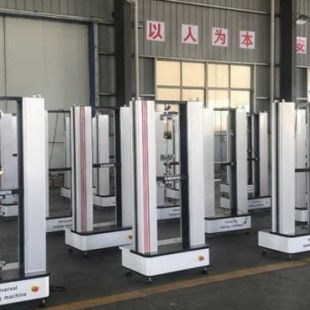
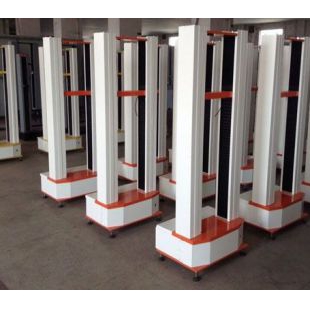
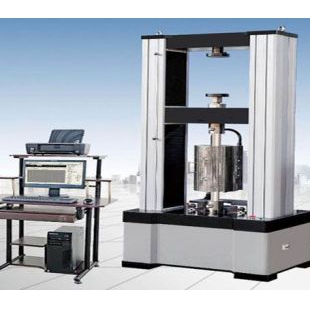
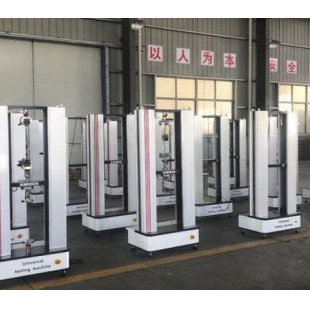
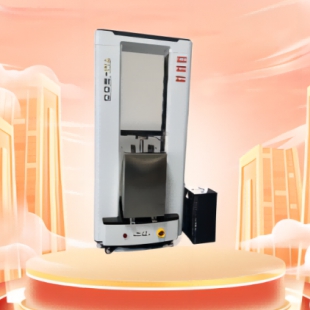
Insulation rod universal tensile testing machine [Return Speed] Set the crossbeam return speed according to test requirements;
[Test Loading Mode] Set the test loading speed according to test requirements,可以选择位移加载、力加载;
[Test Mode] Optional: break/constant force value/constant deformation;
[Start Breakpoint Judgment] Set the force value for generating breakpoints according to test requirements;
[Fracture Comparison] Optional: maximum force/previous force;
[Fracture Judgment Percentage] Can be set according to test requirements;
[Loading Speed] Can be set according to test requirements;
[Hold Value] Hold the distance in mm;
[Hold Time] Optional force holding time duration;
[Gauge Length] Can be set according to test requirements;
[Area] Can be set according to test requirements;
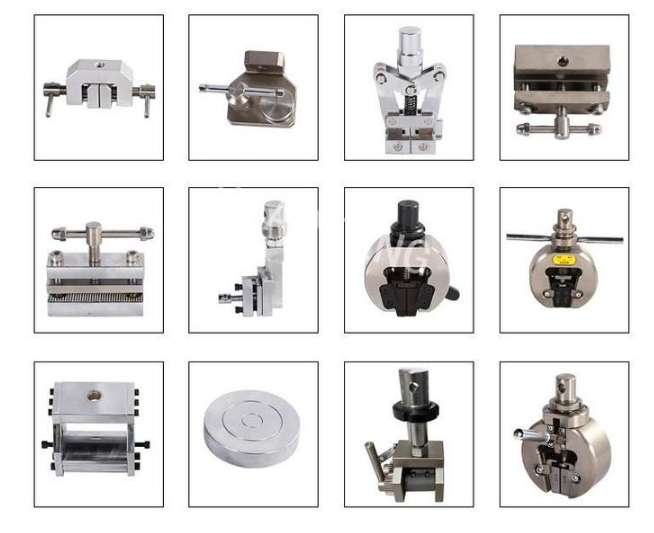
Insulation rod universal tensile testing machine
4) Input the save file name for test data. If not entered, the software has a default save file name; 5) In the software "User Parameters" interface, input user parameters such as specimen dimensions; 6) Use the manual control box to adjust the crossbeam position according to specimen dimensions, install fixtures, set limit switches, then adjust the crossbeam to a suitable position and zero the displacement in the software, set the current crossbeam position as zero point (if automatic return is needed, zeroing displacement is necessary), and zero the force sensor; 7) Clamp the specimen, attach extensometer or large deformation device (if tests requiring extensometer or large deformation); 8) After confirming test parameters are correct, press the run button on the manual control box or at the top of the software to start the test; 9) When reaching the extensometer switch point, remove the extensometer; (if using extensometer for test) 10) After the test ends, remove the specimen; 11) If continuing tests, repeat steps 6 to 10; 12) Generate test report (refer to 3.3.11) 13) If not testing, go offline, exit software, shut down computer; 14) Turn off the main power of the testing machine.
a. Use FESTO servo motor, high efficiency, energy saving, low noise, high torque, reliable quality;
b. The oil pump uses Voith internal gear pump to further improve system stability. The characteristics of this internal gear pump:
● Adopts its technology, using axial and radial pressurization methods to improve efficiency;
● Uses involute internal gear meshing transmission, low noise, excellent durability and long life;
c. The oil pump suction port is equipped with a filter with filtration accuracy of 100μ;
d. The oil pump motor unit is equipped with vibration damping devices (using damping pads) to reduce vibration and noise;
2.3 High and low pressure switching valve group: Uses mature solenoid valve and relief valve combination technology for soft high/low pressure switching (automatically controlled by servo controller);
2.2.4 Pressure stabilizing accumulator device:
a. Equipped with a precision filter with filtration accuracy of 3 microns, the filter has a blockage alarm device, and its installation position is convenient for replacing filter elements;
b. Equipped with accumulator for energy storage and pressure stabilization to ensure stable system pressure;
2.2.5 Servo oil tank:
All pipelines, joints, and seals from the module to the actuator use domestic brand-name components;
2.2.9 Electrical control system:
a. Realize electrical control of the oil source system;
b. The oil source system has automatic shutdown or alarm functions for temperature over-limit, filter blockage, low liquid level, etc.;
1. Electro-hydraulic servo control system: Uses full digital servo controller to realize closed-loop electro-hydraulic servo control of the system; equipped with computer screen display, data acquisition and processing system to realize automatic processing of test results;
2. Main components of the controller:
a. Three-channel signal conditioning units (test force, displacement, deformation);
b. Servo valve drive unit;
c. Signal generator unit;
d. Other necessary I/O input/output units;
3.2 Main functions for dynamic and static test control:
a. The controller can independently complete PID closed-loop dynamic test control of test force or displacement (amplitude) channels, i.e., dynamic tests with certain test force or test displacement (deformation), test frequency, and signal type. During the test, new test parameters can be modified and set without interrupting the test. At the same time, the controller can also be used for static test control, such as constant test force rate or constant displacement rate tests, various long-term holding tests, or ramp combination tests. The controller is also equipped with analog signal input and output interfaces to facilitate connection with the computer for system function expansion, such as data acquisition and processing;
b. Has complete peripheral equipment control capability, can perform start/stop control of oil source, high/low pressure switching control, and also complete parameter calibration, zero clearing, parameter storage and loading of various sensors;
c. The controller's function signal generator (with built-in cycle counter) generates command waveforms such as sine, square, triangle, and ramp. It has multiple display modes, such as test count, peak-valley values of various test parameters, real-time values, etc. It also has automatic shutdown or alarm functions for over-limit or over-set test parameters;
3.3 German DOLI EDCi50 controller:
a. Fully enclosed standard servo oil tank, designed with a tank volume of 4-6 times the pump flow rate;