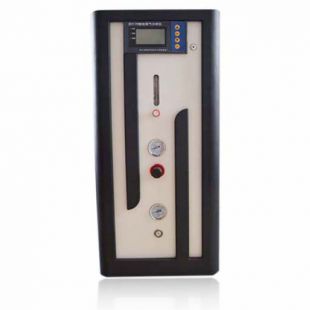
Main Features:
1. Can replace high-pressure nitrogen cylinders, making laboratory instrumentation safer.
2. Fully automatic control during operation, simple to operate, and easy daily maintenance.
3. Digital display of nitrogen production rate for easy observation of instrument working status and fault diagnosis.
4. Long lifespan, can be used continuously or intermittently, with stable gas production and no degradation.
8. Program-controlled intelligent self-diagnosis function and service reminder function for easy maintenance.
9. Highly integrated modular structure design saves laboratory space.
10. Built-in gas storage tank pressure stabilization unit with international standard safety valve design.
11. Mobile design with casters for easy movement.

Technical Parameters:
Model | AYAN -300MLG | AYAN -500MLG |
Output Pressure | 0-0.4Mpa | 0-0.4Mpa |
Pressure Stability | <0.2% | <0.2% |
Nitrogen Purity | >99.999% | >99.999% |
Maximum Power | 150W | 150W |
Output Interface | 3mm or 1/8in (M8×1 external thread) | 3mm or 1/8in (M8×1 external thread) |
Liquid Tank Volume | 1.2 liters | |
Water Consumption | Approximately 10ml/h | |
Water Quality Requirement | Resistivity ≥1MΩ/cm | |
Power Supply Voltage | AC 230V (50/60 Hz) Fuse: 250V/2A | |
Working Conditions | Temperature 10-40℃, relative humidity <85%, no heavy dust | |
Dimensions | 400×250×350 (L×W×H) | |
Working Mode | Continuous operation | |
Anyan brand nitrogen generators can be customized with various flow rates and purities of 99%, 99.9%, 99.99%, 99.999%, 99.9999%. Welcome to purchase! | ||
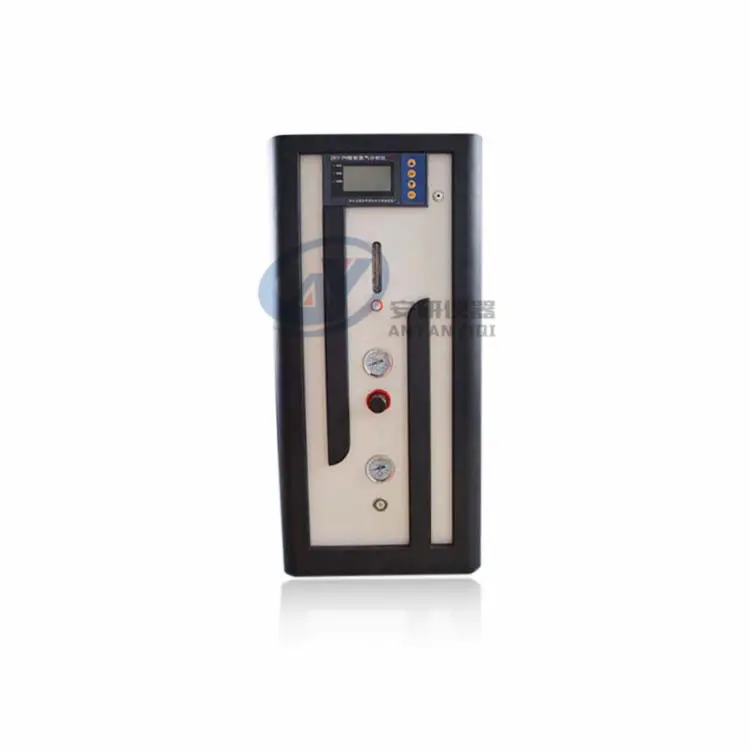
High Purity Nitrogen Generator AYAN -300MLG Nitrogen Production Device
When using the nitrogen generator, the flow indication should be consistent with the gas consumption of the chromatograph. If the flow indication is significantly higher than the actual usage of the chromatograph, stop the machine immediately for leak detection, adjust according to the instrument's fault causes and troubleshooting methods, then perform self-check. Only after passing the inspection can it be used.
During normal use of the nitrogen generator, pay attention to adding deionized water. Each addition should not exceed the upper limit of the liquid level. The frequency of adding deionized water depends on the amount of nitrogen used and the ambient temperature. For the replacement of color-changing silica gel, when the bottom of the desiccant turns red, it needs to be replaced. Release the nitrogen from the instrument, unscrew the entire desiccant cartridge, and then replace it. After ensuring the rubber surface inside the top cover of the desiccant cartridge is free of desiccant and tightened, align the desiccant cartridge with the desiccant base and screw it on.
There are mainly two methods for installing the purification tube of the nitrogen generator. Below, the editor will introduce them to you.
1. Vertical installation: The inlet and outlet of the purification tube are both at the bottom of the instrument, with openings facing upward. This method has two types:
(1) Add a guide tube inside the purification tube, load the adsorbent into the purification tube. Gas first passes through the adsorbent and then is output through the guide tube. This method is mostly used for stainless steel tubes, but stainless steel tubes are opaque, which is not conducive for users to directly observe changes in the adsorbent.
(1) Add a lining tube inside the purification tube, load the adsorbent into the lining tube. Gas first passes through the adsorbent, then through the gap between the purification tube and the lining tube to the bottom of the purification tube for output. This method is affected by structure and processing technology. The lining tube is not easy to remove from the purification tube, and even the gas may not flow through the adsorbent due to the resistance of the adsorbent, causing unfiltered gas to be directly output, which can affect the normal use of the chromatograph.
2. Hanging installation: The inlet and outlet of the purification tube are both at the upper part of the instrument, with the outlet facing downward. The gas from the electrolysis separation tank or compressor enters downward through the protruding inlet in the center of the fixed cover, passes through the inner lining core tube to the bottom of the desiccant, then after being filtered by the adsorbent, it returns upward to the outlet around the fixed cover, thus the gas is effectively filtered before output.
If the nitrogen pressure is low or there is no pressure, but the nitrogen flow rate is high, it is necessary to check whether the equipment is leaking. Use a blind nut to close the nitrogen outlet on the back of the instrument, start the machine and check if the flow indication returns to zero. If the flow does not decrease to a minimum or zero after a few minutes, it indicates that the instrument itself is leaking. Check whether the rubber surface inside the top cover of the desiccant cartridge has desiccant attached and whether the O-ring of the desiccant base is disengaged. If so, it indicates that the connected instrument behind is leaking.